

Twin Cities Buyers Have More Leverage. So Why Doesn't Buying a Home Feel More Affordable?
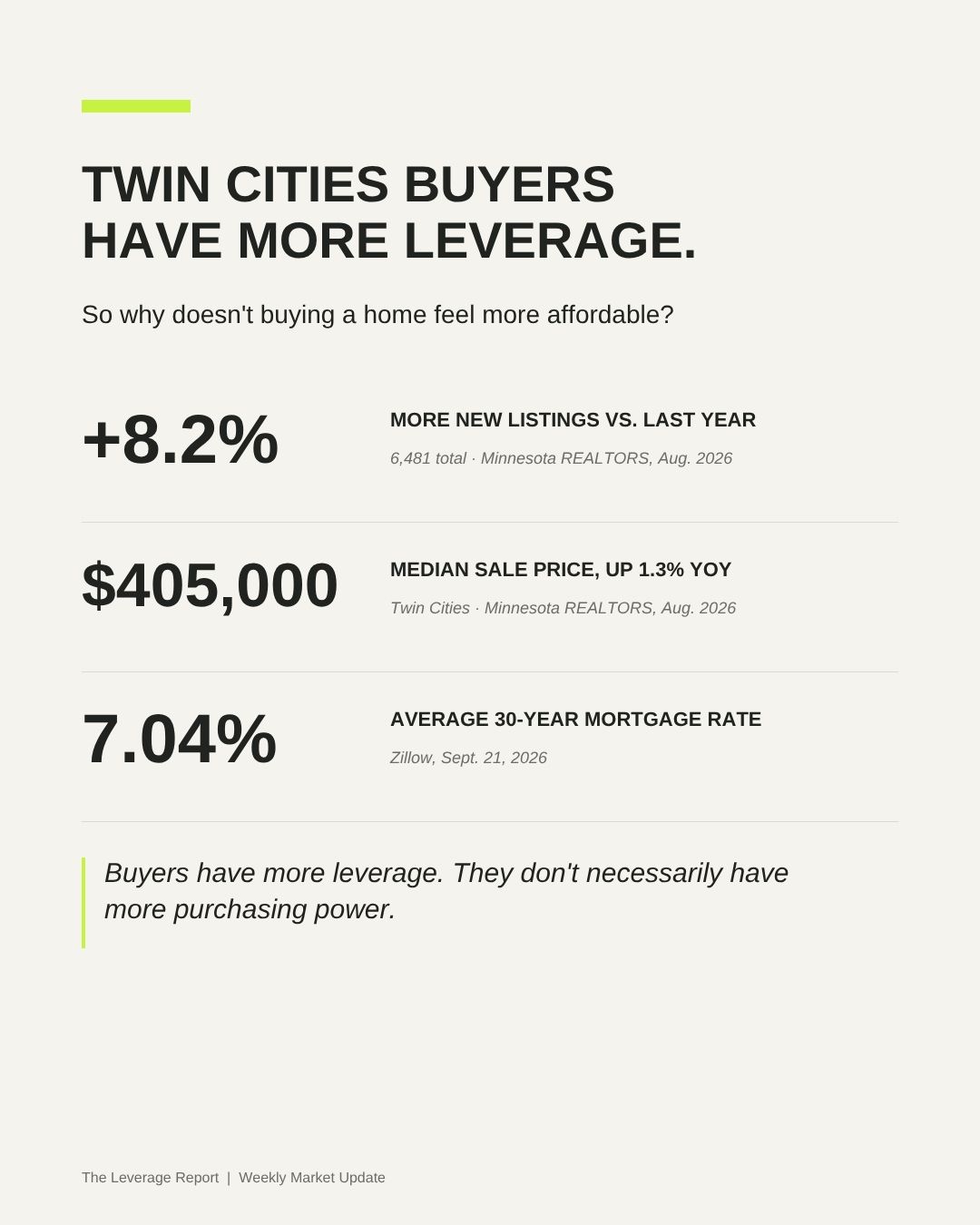
Twin Cities home buyers have more choices and more negotiating leverage than they did a year ago. But buying a home hasn't necessarily become more affordable.
That sounds contradictory.
It isn't.
More homes are coming onto the market. Homes are taking longer to sell. Sellers aren't getting quite as much of their original asking price.
At the same time, Twin Cities home prices are still higher than they were a year ago, and average 30-year mortgage rates are back above 7%.
So buyers are gaining negotiating power while still struggling with purchasing power.
Those are two very different things.
Is the Twin Cities housing market getting better for buyers?
In several important ways, yes.
According to Minnesota REALTORS, new listings in the Twin Cities increased 8.2% year over year in August, reaching 6,481 new listings.
Pending sales increased just 1.1%.
That matters.
More homes are coming onto the market without an equally large increase in homes going under contract. That generally gives buyers more options to consider.
Homes also took a median 45 days to sell, and Twin Cities sellers received an average of 98.2% of their original list price.
For buyers, that can mean more opportunities to:
- negotiate the purchase price
- ask the seller to contribute toward closing costs
- negotiate repairs
- keep important protections like an inspection contingency
- take a little more time before making a decision
But there's an important word in that sentence:
Can.
A well-priced home in a desirable neighborhood can still attract multiple offers.
Another home might sit for several weeks before the seller becomes willing to negotiate.
That's why I don't think broad labels like "buyer's market" tell the whole story anymore.
Are Twin Cities home prices falling?
Not overall.
Despite more listings and slower buyer activity, the Twin Cities median sales price increased 1.3% year over year in August to $405,000.
That's an important distinction.
A housing market can become more favorable to buyers without home prices falling.
Buyers can gain:
More choices.
More time.
More negotiating room.
Those things have real value.
But none of them automatically make the monthly payment cheaper.
That's where purchasing power enters the picture.
What's the difference between negotiating leverage and purchasing power?
Here's the simplest way I can explain it:
Negotiating leverage is what you may be able to get from the seller.
Purchasing power is how much house your money can comfortably buy.
Imagine a seller is more willing to negotiate than they would have been a year ago.
Great.
Maybe you negotiate a lower purchase price. Maybe the seller contributes toward your closing costs. Maybe you don't have to compete aggressively against five other buyers.
You've gained leverage.
But if borrowing the money has become more expensive, your monthly payment can still be higher.
That's exactly the tension buyers are dealing with right now.
What are mortgage rates today?
As of September 21, 2026, the average 30-year fixed purchase mortgage rate was 7.04%, based on Zillow lender-marketplace data.
That puts the average rate back above 7%.
And a seemingly small change in mortgage rates can make a meaningful difference in a buyer's monthly payment.
Here's a simple example using a $300,000, 30-year mortgage:
At 6.5%, principal and interest would be approximately $1,896 per month.
At 7.04%, principal and interest would be approximately $2,004 per month.
That's about $108 more every month.
And that's before property taxes, homeowners insurance, mortgage insurance, HOA dues or other housing expenses.
So while the housing market itself may be giving buyers more breathing room, financing that purchase can simultaneously become more expensive.
Why hasn't more housing inventory made Twin Cities homes more affordable?
Because more inventory doesn't automatically mean falling prices.
Increasing inventory changes the balance between buyers and sellers.
If buyers suddenly have ten homes to consider instead of three, sellers have more competition for those buyers' attention.
That can affect:
- how quickly homes sell
- how aggressively sellers price
- whether sellers make price reductions
- whether buyers can negotiate
- what terms sellers are willing to accept
But prices don't automatically collapse simply because buyers have more choices.
In August, the Twin Cities median sales price was still $405,000 - 1.3% higher than a year earlier.
So far, we're seeing evidence of a market becoming more negotiable without becoming broadly cheaper.
Those are not the same thing.
Is the Twin Cities housing market becoming a buyer's market?
I don't think "buyer's market" or "seller's market" is specific enough to be particularly useful right now.
Consider two houses listed during the same week.
One is priced correctly, shows beautifully and sits in a neighborhood where buyers have very few comparable options.
It could still receive multiple offers.
Another is overpriced, needs work and has three similar homes competing against it.
That seller may have very little leverage.
Same Twin Cities housing market.
Completely different negotiating environments.
That's why I'd rather ask:
How much leverage does a buyer have on THIS house?
That answer depends on the property, price, neighborhood, competition, days on market and the seller's situation.
That's information you can actually use.
What does this mean if you're buying a home in the Twin Cities?
Don't confuse having more negotiating leverage with being able to afford more house.
Start with the payment.
What monthly housing cost actually works for your life?
Not simply what a lender says you qualify to borrow.
Once you establish that number, then you can look for opportunities created by the changing market.
Maybe that's a price negotiation.
Maybe it's asking the seller to pay some closing costs.
Maybe it's negotiating a seller-paid interest-rate buydown.
Maybe it's simply being able to keep an inspection contingency without immediately losing the house to another buyer.
The opportunity isn't necessarily:
"Homes are cheap now."
They're not.
The opportunity may be:
"I have more ways to structure a deal that works for me."
That's a much more useful distinction.
What does this mean if you're selling a Twin Cities home?
More inventory means your home has to compete harder for buyers' attention.
That makes pricing, condition and presentation increasingly important.
The good news for homeowners is that Twin Cities prices haven't broadly collapsed. August's median sales price remained higher than it was a year ago.
But buyers have alternatives.
And when buyers have alternatives, they can afford to be more selective.
That makes this seller strategy increasingly risky:
"Let's start high. We can always lower the price later."
You certainly can.
But the question is what happens while your home sits on the market competing against better-priced alternatives.
A seller can still have tremendous leverage today.
The property simply needs to give buyers a reason to provide it.
So, is now a good time to buy a home in the Twin Cities?
There's no useful universal answer to that question.
The market doesn't know your income, savings, job situation, family plans, current housing costs or what you want your life to look like.
And "the market" isn't buying the house.
You are.
What today's market can tell us is where your opportunities and constraints may be.
Right now, buyers generally have more choices and potentially more negotiating room.
At the same time, mortgage rates above 7% and home prices that remain higher than last year continue to put pressure on affordability.
Whether buying makes sense depends on what those conditions mean for your specific situation.
The simplest way to understand the Twin Cities housing market right now
Here's my takeaway:
Buyers have more leverage.
They don't necessarily have more purchasing power.
More inventory can give buyers more choices, more time and more opportunities to negotiate.
But mortgage rates above 7% and home prices that remain higher than last year mean affordability is still a very real constraint.
Both things can be true at the same time.
And understanding that difference is a lot more useful than trying to decide whether the Twin Cities housing market is simply "good" or "bad."
That's the leverage I'm watching.
Sources: Minnesota REALTORS August 2026 Housing Market Report, using NorthstarMLS and participating MLS data; Zillow lender-marketplace mortgage-rate data reported September 21, 2026. Mortgage-payment examples are principal and interest only and are provided for illustration. Actual mortgage rates, payments and qualification vary by borrower and loan.